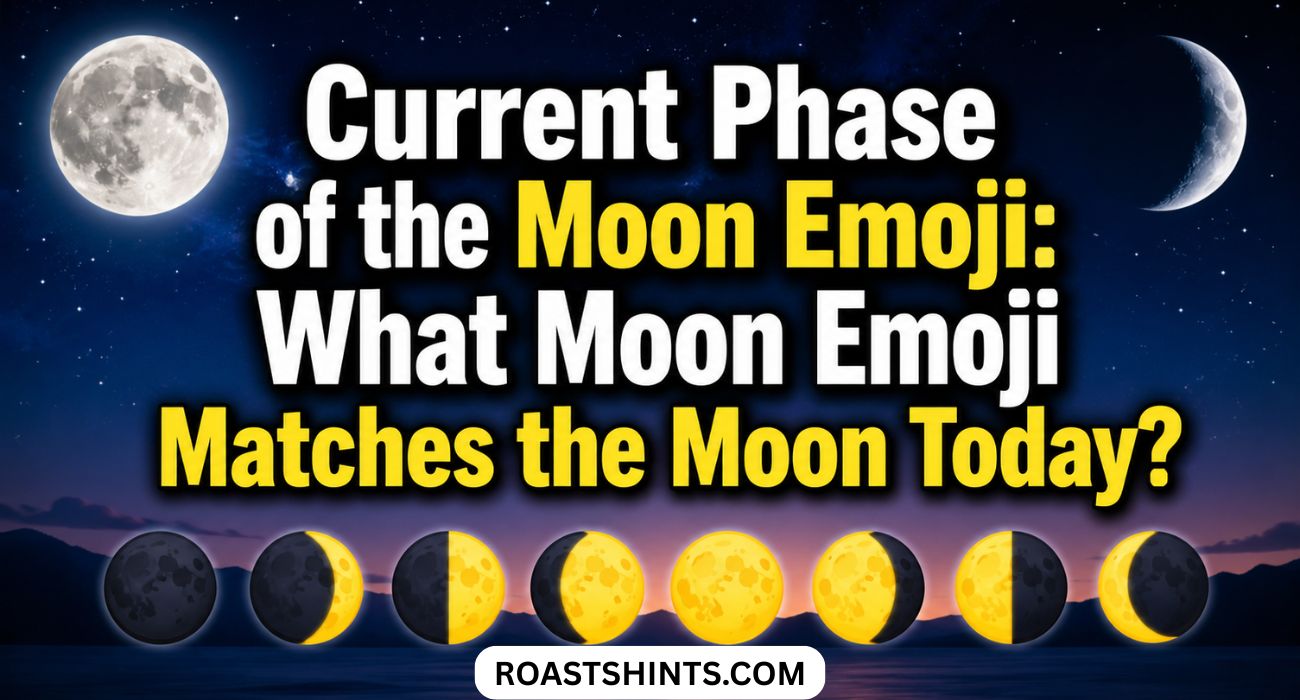
What Is the Current Phase of the Moon as an Emoji?
A moon emoji is a small digital symbol that shows the Moon. It can represent a lunar phase, night, sleep, or beauty. Different moon emojis show different stages of the lunar cycle in a simple way.
The Moon changes a little each night. Its shape can look like a thin crescent or a bright full circle. The right emoji helps you show the Moon’s stage clearly in a message or post.
The current phase of the moon emoji matches the Moon’s real stage today. You can check a moon phase tracker to find the current phase. Then, choose the closest emoji for accurate digital communication.
Read this too: Heart-Touching Goodnight Messages
Understanding Moon Emojis: More Than Just Cute Icons
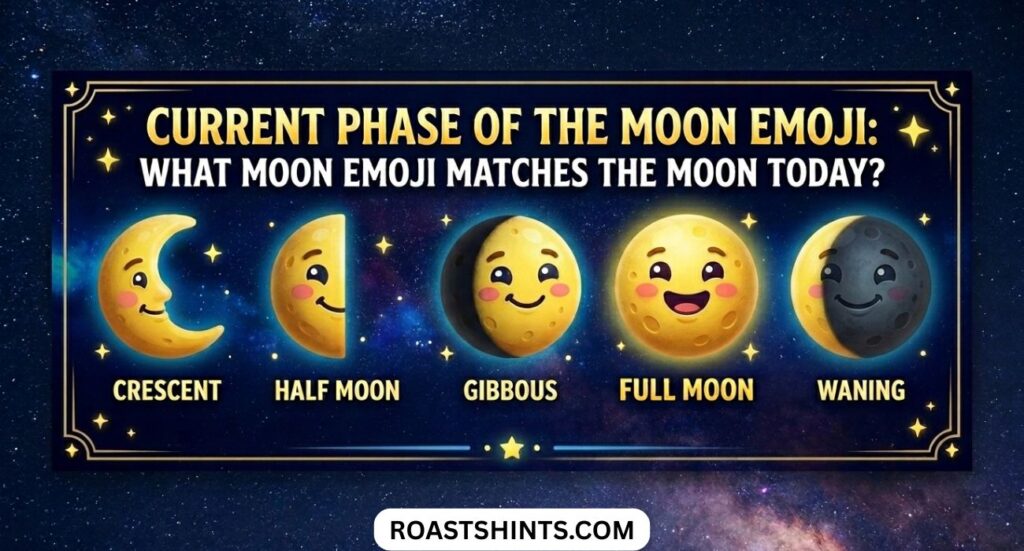
A moon emoji can do much more than decorate a message. It can represent nighttime, mystery, sleep, romance, spirituality, astronomy, or an actual lunar phase.
The standard Unicode set includes eight phase symbols that closely correspond to the eight recognized stages of the lunar cycle. Unicode lists 🌑 through 🌘 as new moon, waxing crescent, first quarter, waxing gibbous, full moon, waning gibbous, last quarter, and waning crescent.
That makes moon emojis useful when you want to communicate a lunar stage quickly. However, the emoji itself does not automatically update when the Moon changes in the sky.
Current Phase of the Moon Emoji: The Basic Match
The easiest way to understand the moon phase emoji system is to match each symbol with its astronomical phase.
| Actual lunar phase | Closest emoji | What it shows |
| New Moon | 🌑 | Little or no visible illumination |
| Waxing Crescent | 🌒 | A thin growing crescent |
| First Quarter | 🌓 | About half illuminated |
| Waxing Gibbous | 🌔 | More than half illuminated and growing |
| Full Moon | 🌕 | Nearly the entire visible disk illuminated |
| Waning Gibbous | 🌖 | More than half illuminated but decreasing |
| Last Quarter | 🌗 | About half illuminated |
| Waning Crescent | 🌘 | A thin decreasing crescent |
NASA identifies these as the eight lunar phases and explains that they repeat in a cycle of about 29.5 days.
Do Moon Emojis Match the Real Moon Phase?
Yes, but only as a representation.
The Unicode moon symbols were designed to correspond with lunar phases, so 🌒 is intended to represent a waxing crescent and 🌕 a full moon. Unicode specifically describes U+1F311 through U+1F318 as a systematic set of eight Moon-phase symbols.
However, the Moon does not jump from one emoji to another. Its illuminated portion changes continuously. An emoji gives you a simplified visual category rather than an exact astronomical measurement.
This distinction is important when discussing emoji representation and emoji accuracy. For casual texting, an approximate symbol is usually enough. For astronomy content, a real-time lunar calculation is more appropriate.
Real-Time Moon Phases: How to Check the Actual Lunar Phase
The current moon phase depends on the date and time you are checking. Your location can also matter when you want information such as moonrise, moonset, or what the Moon looks like from your part of Earth.
NASA explains that Moon phases occur because we see different portions of the Sun-illuminated half of the Moon as it orbits Earth. The complete sequence takes about 29.5 days from one new moon to the next.
For moon phases today, use a reliable real-time moon phase source instead of assuming that the Moon emoji shown on your phone represents today’s sky.
A moon phase tracker can provide the illumination percentage, phase name, moonrise and moonset times, and sometimes the Moon’s position in the sky.
A lunar calendar app can be useful if you regularly follow the Moon. It can also help photographers, stargazers, and people who plan outdoor activities around moonlight.
Current Phase of the Moon Emoji Today
On August 15, 2026, the Moon is just a few days past the August 12 new moon. Data for Lahore, Islamabad, and Karachi show approximately 9% illumination on August 15, making 🌒 waxing crescent moon the closest standard phase emoji.
The exact illumination percentage varies slightly by location and calculation time, so a live moon phase calendar should be used when precision matters.
Why This Matters More Than You Think
Choosing a lunar emoji correctly can make a small difference in how clearly your message communicates.
Imagine posting a photo of a thin evening crescent while using 🌕. The message may still look attractive, but the emoji does not match the real moon phase.
For casual social media posts, that mismatch may not matter. For an astronomy page, educational article, science project, or moon photography post, accuracy gives your content more credibility.
It is also a useful example of how technology and nature interact. A small digital symbol can represent an object that is millions of miles away while still requiring real astronomical information to be used accurately.
Expert Insight: Why the Moon Changes Shape
The Moon does not actually change physical shape during its monthly cycle.
The Sun always illuminates half of the Moon. What changes is how much of that illuminated half we can see from Earth as the Moon moves around our planet. NASA describes this changing view as the reason for the eight Moon phases.
This is why moon illumination is a better scientific description than saying that the Moon itself becomes larger or smaller.
The terms waxing moon and waning moon describe the apparent increase or decrease in the illuminated portion visible from Earth.
Understanding waxing vs waning also makes it easier to select the correct emoji. A growing illuminated portion points toward the waxing half of the cycle, while a shrinking illuminated portion indicates the waning half.
How to Match the Current Moon Phase to the Right Emoji
The simplest method is to identify the actual phase first and then choose the corresponding Unicode symbol.
New Moon Emoji — 🌑
The new moon emoji represents the new Moon phase.
At new moon, the side of the Moon facing Earth is largely unilluminated from our viewpoint. It is therefore difficult or impossible to see under ordinary conditions.
The new Moon begins the commonly described sequence of eight phases.
Waxing Crescent Moon — 🌒
The waxing crescent moon represents the first visible crescent after new moon.
A small portion of the Moon becomes illuminated, and that visible portion grows over the following days.
On August 15, 2026, this is the best standard emoji match for the Moon in Pakistan, because the Moon is only around 9% illuminated.
The waxing crescent meaning is therefore closely connected with growth, increasing illumination, and the beginning of a new lunar cycle.
First Quarter Moon — 🌓
The first quarter moon looks approximately half illuminated.
Despite its name, it does not mean that only one quarter of the Moon is visible. It refers to the Moon being about one quarter of the way through its complete phase cycle.
The first quarter moon meaning can be scientific or symbolic depending on the context.
Waxing Gibbous Moon — 🌔
The waxing gibbous moon occurs after first quarter and before full moon.
More than half of the visible lunar disk is illuminated, and the illuminated portion continues increasing.
The waxing gibbous meaning is often associated with progression toward the full Moon.
Full Moon Emoji — 🌕
The full moon emoji is one of the most recognizable celestial symbols.
During a full moon, the visible face of the Moon is almost completely illuminated. It is often especially bright and noticeable in the night sky.
The full moon meaning can be scientific, cultural, romantic, spiritual, or simply aesthetic.
Waning Gibbous Moon — 🌖
The waning gibbous moon follows the full Moon.
More than half of the Moon remains illuminated, but the visible illuminated portion is now decreasing.
The waning gibbous meaning is therefore connected with the part of the lunar cycle that follows maximum illumination.
Last Quarter Moon — 🌗
The last quarter moon appears roughly half illuminated.
It is sometimes called the third quarter. Both names refer to the same general phase.
The symbol is especially useful when you want your moon emoji symbols to communicate a specific lunar stage rather than simply “night.”
Waning Crescent Moon — 🌘
The waning crescent moon is the final major phase before the cycle reaches new moon again.
Only a thin portion remains illuminated, and the visible crescent continues shrinking.
The waning crescent meaning can be interpreted scientifically as the final stage of the visible lunar cycle, while symbolic traditions may give it additional meanings.
Emoji Use in Astrology and Rituals
Moon imagery has a long history outside astronomy.
In modern digital communication, people use lunar symbols in astrology posts, spiritual content, meditation posts, journals, and discussions about moon rituals.
This creates an important distinction between astronomy and symbolism. Astronomy describes measurable positions, illumination, and orbital motion. Astrology interprets celestial positions through a symbolic or cultural framework.
The terms astrology symbols and astrology moon phases therefore belong to a different context from astronomical phase calculations.
Moon Phase Symbolism in Digital Communication
The Moon can also carry emotional meaning.
A crescent may suggest mystery or quietness. A full Moon can suggest brightness, completion, or intensity. A new Moon may be associated symbolically with beginnings.
These ideas contribute to moonlight symbolism, moon symbolism, and the broader use of celestial imagery online.
Expressions such as full moon energy and new moon beginnings are common in spiritual and lifestyle content, but they should not be confused with scientific descriptions of lunar effects.
Similarly, moon rituals and emojis combine a digital symbol with a cultural or spiritual practice rather than describing an astronomical measurement.
Moon Emojis and Platform Differences
The same Unicode character can look slightly different on different devices.
Apple, Google, Samsung, Microsoft, and other platforms create their own emoji artwork. The underlying Unicode character identifies the symbol, but the visual design can vary.
This matters when comparing iPhone/Android moon emoji designs. A crescent may have slightly different shading, orientation, texture, or color depending on the operating system.
Unicode’s emoji standard focuses on the encoded character and interoperability rather than forcing every company to use exactly the same artwork.
Moon Emoji on iPhone and Android
The moon emoji on iPhone and the moon emoji on Android generally communicate the same basic concept, but their artwork may differ.
This does not usually change the intended meaning. However, it can affect how accurately a particular emoji appears to match a photograph or astronomy illustration.
That is why moon emojis across platforms should be treated as visual representations rather than precision astronomical diagrams.
Understanding What Is the Current Phase of the Moon as an Emoji
The answer is simple: identify the Moon’s actual astronomical phase and then choose the Unicode emoji that represents that phase.
For August 15, 2026, the closest match in Pakistan is 🌒, because the Moon is in its waxing crescent stage and is around 9% illuminated.
The important distinction is that the emoji does not know today’s date. It remains the same Unicode character whether you use it today, next month, or several years from now.
Therefore, the current moon phase as an emoji is something you determine by comparing current astronomical data with the available lunar symbols.
Read also: Happy New Month Messages for Friends
How Real-Time Moon Phases Differ from Emoji Representation
A lunar phase emoji provides a category. Real lunar data provides a measurement.
For example, the Moon could be 8%, 9%, or 12% illuminated while still being described broadly as a waxing crescent. There is no separate standard Unicode emoji for every possible illumination percentage.
This is why moon phase today searches and live astronomy tools are more precise than simply looking at an emoji list.
The actual lunar phase also changes continuously. An emoji set contains a limited number of symbols, so it cannot display every subtle change in the Moon’s illumination.
Why Emoji Accuracy Has Limits
Unicode provides standardized names and characters, but it does not turn emojis into live astronomical instruments.
The Unicode standard defines emoji characters and related technical information. Unicode’s current emoji specification also emphasizes interoperability across platforms.
The result is a useful set of digital moon symbols, not a real-time lunar display.
That distinction is central to astronomy accuracy. If you need exact illumination, phase timing, or moonrise information, use astronomical data rather than relying on a visual symbol.
Why Using the Right Moon Phase Emoji Matters
The right emoji makes communication clearer.
If you are discussing the Moon scientifically, matching the symbol to the real phase prevents unnecessary confusion. If you are simply decorating a nighttime message, accuracy may be less important.
For educational websites, however, moon phase communication should ideally use the correct phase name and symbol together.
For example:
🌒 Waxing Crescent — about 9% illuminated
is much clearer than using 🌕 simply because it looks attractive.
The same principle applies to celestial emoji meanings. A symbol can have both a literal astronomical interpretation and a broader emotional meaning depending on context.
Tools to Check the Current Moon Phase Before Choosing an Emoji
A reliable moon phase tracker app is one convenient option for checking the Moon before selecting an emoji.
You can also use a lunar calendar or astronomy website. These tools commonly provide phase dates, illumination, moonrise, moonset, and sometimes the Moon’s position in the sky.
For scientific or educational work, astronomy websites from established organizations are preferable to social media graphics because they provide more context about the calculation.
NASA’s Moon phases resource explains the complete sequence and provides educational material about how the phases occur.
What to Look For
When checking a phase, pay attention to:
| Information | Why it matters |
| Phase name | Identifies the lunar stage |
| Illumination percentage | Shows how much of the visible disk is lit |
| Date and time | Lunar illumination changes continuously |
| Location | Important for moonrise and moonset |
| Phase direction | Helps identify waxing or waning |
| Moonrise time | Useful for observation and photography |
A moon phase chart can provide a quick visual overview, while a moon phase calendar app is more useful when you need daily or hourly information.
NASA also provides educational Moon-phase charts and calculators that show the sequence from new moon through the seven following phases.
Moon Emojis and Their Connection to Astrology Symbols
Moon emojis and astrological glyphs may look related, but they serve different purposes.
A moon emoji is primarily a digital character used in communication. An astrological symbol belongs to a symbolic system used to represent celestial bodies, signs, or positions.
This is why moon symbols can have multiple meanings depending on where they appear.
For example, 🌙 might simply mean “good night” in a text message. In another setting, a Moon symbol might refer to astrology, spirituality, astronomy, or traditional lunar calendars.
Moon Phases and Astrology
People who follow astrology often connect different lunar stages with themes such as reflection, growth, completion, and renewal.
These interpretations are part of moon phases and astrology, rather than astronomical evidence about the physical effects of the Moon.
Using a lunar emoji in an astrology post can therefore be perfectly appropriate, provided the symbolic interpretation is not presented as a scientific fact.
Moon Emojis Across Platforms and Emoji Accuracy Differences
There are two kinds of accuracy to consider.
The first is Unicode accuracy: whether the character corresponds to the intended standardized emoji.
The second is visual accuracy: whether the artwork on a particular device looks like the actual Moon.
Unicode’s emoji documentation identifies the standard phase characters, including 🌑, 🌒, 🌓, 🌔, 🌕, 🌖, 🌗, and 🌘.
However, platform designers control the appearance of those characters.
That means moon emoji accuracy is sufficient for ordinary digital communication but should not be treated as a replacement for a scientific lunar diagram.
The Eight Stages of the Lunar Cycle at a Glance
The eight stages of the lunar cycle follow a predictable order.
🌑 New Moon → 🌒 Waxing Crescent → 🌓 First Quarter → 🌔 Waxing Gibbous → 🌕 Full Moon → 🌖 Waning Gibbous → 🌗 Last Quarter → 🌘 Waning Crescent
NASA confirms this eight-phase sequence and explains that the complete cycle repeats approximately every 29.5 days.
The Moon’s orbit around Earth takes about 27.3 days relative to the stars, but the familiar cycle from one new Moon to the next takes about 29.5 days because Earth is also moving around the Sun.
This difference is one of the most useful astronomy facts to understand when learning about lunar phases.
Moon Phase Meanings in Everyday Digital Communication
A lunar symbol does not have only one meaning.
The same emoji can communicate an astronomical phase, a mood, a time of day, or a symbolic idea.
For example, 🌙 often appears in goodnight messages even though it is not necessarily intended to identify the actual phase of the Moon.
This is why moon emoji meaning depends heavily on context.
Common Uses of Moon Emojis
A person might use a crescent moon to suggest sleep or nighttime. A full Moon might appear in a photography caption. A waxing crescent might be used in an astronomy post or a spiritual journal.
These different examples demonstrate how lunar emoji usage works in modern digital communication.
They also show why moon phase meanings today can have two layers: a factual astronomical meaning and a personal or cultural meaning.
Astronomy and Emojis: Where Science Meets Digital Communication
The connection between astronomy and emojis is surprisingly useful.
Astronomy deals with real objects, measurements, orbital mechanics, illumination, and observation. Emojis turn some of those concepts into compact visual characters that people can use instantly.
This makes celestial emojis useful in science communication, classroom discussions, social posts, and casual conversation.
Still, a symbol should not replace the underlying scientific explanation when precision matters.
Using Moon Emojis for Stargazing and Moon Photography
Moon symbols can also help people plan stargazing and night-sky activities.
A bright full Moon can illuminate the landscape but may make faint stars harder to see. A thinner crescent can create darker skies, depending on when it is above the horizon.
For night sky observation, moonrise and moonset times are often just as important as the phase name.
Photographers can also use phase calendars to plan images involving landscapes, buildings, or the Moon itself.
A moon phase calendar app can therefore be useful for both casual observation and more serious moon photography.
Why the Current Moon Emoji Can Change From Day to Day
The Unicode character itself does not change.
What changes is the astronomical condition that the symbol is being used to represent.
For example, someone may use 🌒 today because the Moon is a waxing crescent. Several days later, 🌔 may be a much better match as the illuminated portion grows.
This is the key difference between a fixed emoji and real-time lunar data.
The Moon follows nature’s cycle. The emoji remains stored in your keyboard until you decide which symbol to select.
A Simple Method for Matching Emojis to Moon Phases
If you want a quick system for matching emojis to moon phases, use three steps.
First, check the current lunar phase using a reliable astronomy source.
Second, determine whether the Moon is waxing or waning.
Third, select the Unicode symbol that corresponds to that phase.
For example, if a tracker says “waxing crescent,” choose 🌒. If it says “full moon,” choose 🌕.
This approach makes matching moon emoji choices much more accurate without making the process complicated.
Moon Emoji Meanings: Literal vs. Symbolic
A useful way to understand moon emoji meanings is to separate literal and symbolic use.
A literal use identifies a lunar phase. A symbolic use communicates an idea such as nighttime, calmness, mystery, romance, spirituality, or sleep.
Neither use is wrong.
The key is knowing what you are trying to communicate. If you are writing about today’s astronomy, use the phase that matches the sky. If you are writing “Good night 🌙,” the emoji is functioning primarily as a nighttime symbol.
Current Moon Phase as an Emoji: Quick Reference
For everyday use, this quick reference is enough:
🌑 = New Moon
🌒 = Waxing Crescent
🌓 = First Quarter
🌔 = Waxing Gibbous
🌕 = Full Moon
🌖 = Waning Gibbous
🌗 = Last Quarter
🌘 = Waning Crescent
NASA uses the same eight-phase sequence in its educational explanation of the lunar cycle.
Why Using the Right Moon Phase Emoji Matters
Choosing the right moon phase emoji helps readers understand your message quickly. It shows whether you mean a new moon, waxing crescent, full moon, or another stage. When an emoji matches the current moon phase, your content becomes clearer and more useful. This small detail can improve moon phase communication while connecting astronomy facts with everyday digital communication.
Accurate emoji selection also supports semantic relevance because it connects related concepts such as moon emoji meaning, lunar phases, moon symbols, and celestial emojis. Whether you are writing about stargazing, astrology, or social media, matching the emoji with the real moon phase creates a better experience. It also shows attention to astronomy accuracy and helpful information.
See also: Good roasts that hurt
Tools to Check the Current Moon Phase Before Choosing an Emoji
Before choosing a current moon emoji, check a reliable moon phase tracker or lunar calendar. These tools show the current lunar phase, illumination percentage, moonrise, and moonset times. A moon phase tracker app can make this process simple, while astronomy websites can provide detailed real-time lunar data for accurate results.
A reliable moon phase calendar is especially useful when you need to identify the actual lunar phase before selecting an emoji. You can compare the reported phase with the eight standard Unicode moon emojis. This method helps with matching emojis to moon phases, improves astronomy accuracy, and prevents confusing a decorative symbol with today’s actual lunar appearance.
FAQ’s
What is the 🌕?
🌕 is the full moon emoji, representing a bright, fully illuminated Moon. It can also symbolize nighttime, completeness, or lunar beauty.
What does 🌚 mean in slang?
🌚 often suggests sarcasm, awkwardness, mischief, or a hidden meaning. Its meaning depends on the conversation and tone.
What is 🌜?
🌜 is the last quarter moon face emoji, commonly used for nighttime, sleep, mystery, or a playful lunar mood.
Is 🌚 flirty?
Yes, 🌚 can be flirty when used with a suggestive or teasing message. However, it can also simply express sarcasm, mischief, or awkward humor.
Final Thoughts
The current phase of the moon emoji helps people connect digital messages with the Moon in the sky. Each emoji shows a different lunar stage, such as a new moon, crescent, quarter, gibbous, or full moon. Checking the real Moon phase first helps you choose the closest emoji and share accurate information with others in daily communication.
Moon emojis also add meaning to texts, posts, and captions. They can show night, beauty, mystery, or a lunar stage. A moon phase tracker can give accurate details about today’s Moon. By combining real lunar information with the right emoji, you can make your content simple, clear, useful, and easy for everyone to understand.