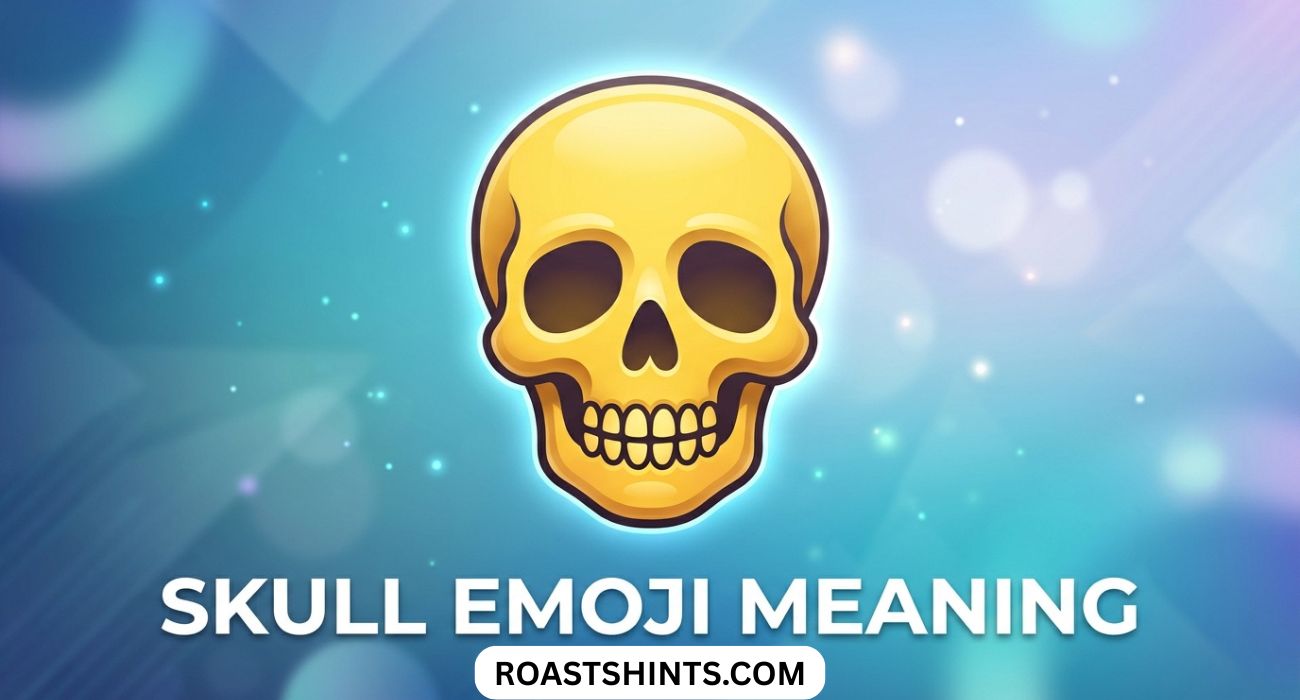
Skull Emoji Meaning Explained: What It Really Means
The skull emoji meaning often shows strong feelings in online chats. People use 💀 to show laughter, shock, or embarrassment. It can also mean death or danger in serious situations.
A small emoji can say much more than words. The 💀 emoji can make a funny message feel stronger. Its meaning changes when the message and situation change.
Today, people often use 💀 in texts and social media. It can show humor, disbelief, cringe, or emotional overload. Understanding the context helps you read its meaning correctly.
Read this too: IGHT meaning in text
Skull Emoji Meaning: What Does 💀 Really Mean?
The modern skull emoji has several meanings. In casual online conversations, it most often expresses a strong reaction rather than literal death.
Someone may send 💀 after reading a hilarious joke, watching an embarrassing video, or seeing an unexpected comment. The person may be saying, “That killed me,” “I cannot handle this,” or “That was too funny.”
So, what does 💀 mean in everyday digital communication? Usually, it signals laughter, shock, disbelief, embarrassment, or emotional overload.
The important point is that the skull symbol does not have one fixed meaning. Its interpretation depends on the message, relationship, platform, and subject being discussed.
Common meanings of 💀
| Meaning | What it communicates | Example |
| Laughter | Something is extremely funny | “That video 💀” |
| Shock | Something was unexpected | “He actually did it 💀” |
| Embarrassment | A painfully awkward moment | “I called him the wrong name 💀” |
| Cringe | Secondhand embarrassment | “Why would he post that 💀” |
| Dark humor | An ironic reaction to a difficult subject | “Monday is already killing me 💀” |
| Literal death | Actual death or danger | “The warning sign showed a skull 💀” |
In other words, the emoji can move from playful humor to a serious symbol depending on its surroundings.
Initial Signification Of The Skull Emoji
Before social media gave 💀 a humorous personality, skull imagery had a much more serious role.
A skull traditionally represents literal death, mortality, danger, or something associated with poison. You can still see skull imagery on warning labels, hazardous materials, pirate imagery, horror artwork, and other serious or dramatic settings.
The connection between a skull and death is much older than emojis. Human cultures have used skulls as symbols of mortality, danger, fear, and the temporary nature of life.
The emoji therefore did not begin as a joke. Its original visual meaning remains important, especially when it appears beside words related to death or safety.
For example, a message saying “Keep away from this chemical 💀” could communicate danger or poison, not laughter.
The same visual can also appear in movies, Halloween content, horror stories, games, and other material connected with horror.
That older meaning has not disappeared. Instead, internet users added another layer to it.
How The Skull Emoji Meaning Changed On Social Media

Social media transformed the way people communicate. Instead of writing complete reactions, users often respond with one emoji.
The skull emoji meaning on social media became strongly connected with exaggerated reactions. People began using 💀 as a visual version of saying, “I’m dead,” especially after something made them laugh.
Consider this exchange:
“I practiced my speech for an hour and then forgot my own name.”
“💀”
The second person is not talking about death. It is a humorous response that communicates extreme amusement and perhaps some sympathy for the embarrassing moment.
This use became especially common through memes, short videos, comments, and viral posts. Online communities constantly create new forms of emoji slang, and 💀 became one of the most recognizable examples.
The phrase “I’m dead” already existed as slang for being extremely amused. The skull emoji gave that phrase a simple visual form.
Today, skull emoji slang can therefore mean something close to “That was hilarious,” “That took me out,” or “I cannot believe what I just saw.”
This is one reason the emoji has become such an important part of digital communication.
Skull Emoji Meaning Facts Table
The following table gives a quick overview of the most common interpretations.
| Emoji | Main meaning | Typical context |
| 💀 | Extreme reaction | Funny or unexpected content |
| 💀 | Laughing too hard | Jokes, memes, videos |
| 💀 | Shock | Unexpected news or behavior |
| 💀 | Embarrassment | Awkward situations |
| 💀 | Secondhand cringe | Someone else’s embarrassing moment |
| 💀 | Dark humor | Ironic or exaggerated jokes |
| 💀 | Literal death | Serious discussions or warnings |
The modern skull emoji meaning today is therefore broader than its traditional definition. Context remains the deciding factor.
Skull Emoji Meaning In Text Messages
The skull emoji meaning in texting is usually playful when friends or family use it in casual chats.
Instead of writing a long reaction, someone can simply send 💀. The emoji may communicate laughter, surprise, disbelief, or embarrassment without any additional explanation.
For example:
“I walked into the wrong classroom and sat down for five minutes 💀”
Here, 💀 represents embarrassment and humor.
Another example is:
“She really sent that message to the group chat 💀”
This can express surprise, amusement, or disbelief.
In private chats, people also combine the skull with other emojis or repeat it several times. A message such as “💀💀💀” normally intensifies the reaction.
This is why skull emoji in texting has become so common among people who regularly use internet slang.
The meaning can change with the relationship, too. A close friend may immediately understand 💀 as a joke, while someone unfamiliar with online slang might interpret it literally.
Skull Emoji Meaning By Context
Understanding skull emoji meaning in chat requires more than looking at the emoji alone.
Read the entire sentence, consider the topic, and think about the relationship between the people communicating. The same emoji can sound funny in one message and serious in another.
Casual Conversations
In casual conversations, 💀 usually shows humor or an emotional reaction.
Friends may use it after telling embarrassing stories, sharing memes, or reacting to something unexpected.
For example:
“I smiled at someone because I thought they were smiling at me. They were talking to someone behind me 💀”
The skull does not suggest death. It communicates embarrassment and amusement.
This is also a common example of skull emoji in casual conversation.
Dark Humor
Dark humor is another common setting for 💀.
People sometimes use the emoji when joking about stress, failure, bad luck, or uncomfortable situations. The emoji makes the reaction feel exaggerated and ironic.
For example:
“My alarm did not go off and my meeting starts in five minutes 💀”
The person is not describing a fatal situation. They are using exaggeration to show how badly things are going.
Still, dark jokes can be sensitive. What seems funny to one person may feel inappropriate to another.
Serious Topics
The meaning changes when 💀 appears in a discussion about real death, danger, or safety.
For example:
“The package contains a toxic substance. The label has a skull and crossbones.”
Here, the emoji or skull symbol has a literal meaning.
It can also appear in conversations about mortality, accidents, crime, illness, or other serious topics.
When the subject itself is serious, do not automatically assume 💀 means laughter. The surrounding words matter more than the popular internet interpretation.
Read also: The brown heart emoji meaning
Skull Emoji Meaning On Different Platforms

The basic interpretation remains similar across social platforms, but each platform has its own communication style.
The skull emoji social media meaning is strongly influenced by memes, comments, viral content, and reaction culture.
TikTok
The skull emoji meaning TikTok users understand is usually humorous.
People frequently place 💀 in comments under videos that are extremely funny, awkward, surprising, or ridiculous. A user may write only “💀” because the video itself provides enough context.
TikTok’s fast-moving meme culture has helped make the emoji a common reaction emoji.
For example:
“The way he walked away after saying that 💀”
The emoji means the commenter found the moment extremely funny.
Twitter or X
The skull emoji meaning Twitter users recognize is also strongly linked to reactions.
On X, people may use 💀 under a viral post, clever joke, surprising statement, or awkward interaction.
Because posts on X often rely on short text, emojis can communicate tone quickly.
A single 💀 can mean “This is hilarious,” while several skull emojis can indicate an even stronger reaction.
The skull emoji meaning Instagram users commonly associate with 💀 involves comments, Reels, Stories, captions, and direct messages.
Someone might comment “💀” under a funny Reel or send the emoji after seeing an embarrassing photo.
It is especially useful when the sender wants to react without writing a full sentence.
Snapchat
The skull emoji meaning Snapchat users see is usually informal and conversational.
Friends may send 💀 in response to funny snaps, awkward moments, strange messages, or surprising stories.
Because Snapchat is strongly associated with personal communication, the emoji often appears as a quick reaction between people who already understand each other’s humor.
Skull Emoji Meaning In Message
A message gives the emoji its emotional direction. Compare these examples:
| Situation | Example message | Likely meaning |
| Joke | “That joke was crazy 💀” | Laughing hard |
| Embarrassment | “I sent it to the wrong person 💀” | Cringe |
| Shock | “He quit without telling anyone 💀” | Disbelief |
| Meme | “This video is too much 💀” | Humor |
| Stress | “Finals start tomorrow 💀” | Exaggerated stress |
| Danger | “Do not touch this chemical 💀” | Literal warning |
These skull emoji examples show why there is no single answer that works for every message.
The best way to understand skull emoji responses is to read the sentence before interpreting the symbol.
Why People Use The Skull Emoji Instead Of Laughing Emojis
A natural question is why someone would use 💀 when emojis such as 😂 and 🤣 already express laughter.
The answer is tone.
The skull often feels more dramatic, ironic, and exaggerated. It does not simply say “I laughed.” Instead, it can suggest that the person found something so funny that they are figuratively “dead.”
That is the main difference between the skull emoji vs laughing emoji.
Compare:
“That joke was hilarious 😂”
with:
“That joke was hilarious 💀”
The first message expresses direct laughter. The second can feel more exaggerated, ironic, or connected to internet humor.
The skull emoji vs 😂 comparison is therefore less about the basic emotion and more about the tone.
The same applies to 🤣. Both can mean strong laughter, but 💀 often has a more modern, meme-driven feeling.
This is part of modern humor, where exaggeration and irony are common ways of communicating emotion.
When Not To Use The Skull Emoji
Knowing when to use skull emoji is useful, but knowing when not to use it is equally important.
Avoid 💀 when discussing someone’s real death or grief unless you are certain the context makes the meaning appropriate. A joke-like reaction can easily appear insensitive.
The same applies to serious health, safety, or personal situations. An emoji that works perfectly in a meme may feel completely wrong during a difficult conversation.
You should also be careful with professional messages.
In formal settings, coworkers, managers, clients, teachers, or customers may not interpret emoji slang the same way your friends do. A skull can look confusing or unprofessional when the intended meaning is simply “That is funny.”
This does not mean 💀 is always inappropriate at work. Informal teams may use it comfortably. However, skull emoji in professional communication should depend on the workplace culture and the people involved.
When in doubt, use clear words.
Skull Emoji Meaning vs Other Emojis
Popular reaction emojis overlap, but each one carries a slightly different tone.
| Emoji | Common meaning | Typical tone |
| 💀 | Extreme reaction | Ironic or dramatic |
| 😂 | Strong laughter | Direct and friendly |
| 🤣 | Very strong laughter | Playful and expressive |
| 😭 | Intense emotion | Dramatic, sad, or joking |
| 😬 | Awkwardness | Uncomfortable or nervous |
| ☠️ | Danger or death | Serious, dark, or warning-related |
The 😭 emoji can sometimes express laughter online, especially when someone is overwhelmed by something funny. The 😬 emoji is more strongly associated with awkwardness or discomfort.
The 🤣 emoji is straightforwardly connected to intense laughter.
The ☠️ emoji, meanwhile, is visually similar to 💀 but has a stronger association with danger, pirates, poison, and the skull-and-crossbones symbol.
This makes the skull emoji vs ☠️ distinction useful. 💀 is often a reaction to content, while ☠️ can feel more like a symbol or warning.
Why The Skull Emoji Meaning Keeps Growing
Internet language changes quickly. Words that once had one meaning can gain new meanings through memes, communities, and social platforms.
The skull emoji is a good example of this process.
Its visual design is simple, but its emotional range is surprisingly large. It can express emotional overload, laughter, embarrassment, disbelief, shock, irony, and even literal danger.
This flexibility makes it useful in modern conversations.
Memes have also played an important role. In meme culture, users often communicate entire reactions through a single symbol. Instead of explaining why something is funny, they simply use 💀.
The emoji has become part of internet culture because it works well with exaggerated reactions. It can make a short message feel stronger without adding many words.
This is also why contemporary emoji usage keeps changing. Users create meanings based on shared experiences, trends, jokes, and online communities.
The role of emotional exaggeration
Online communication does not include facial expressions, voice tone, or body language. Emojis help replace some of those missing signals.
A person who writes “That was funny” gives a simple response.
A person who writes “That was funny 💀” gives the sentence a different emotional tone.
The symbol adds exaggeration and personality.
That makes 💀 an effective form of emotional expression in short digital conversations.
Why meme culture matters
Meme reactions often need to be quick. People do not always want to write a paragraph explaining that something made them laugh.
A skull provides a compact reaction.
It can mean:
“I cannot handle this.”
“I am laughing too hard.”
“That was painfully awkward.”
“I cannot believe this happened.”
This flexibility explains why the emoji continues to appear in online conversations.
Understanding The Skull Emoji In Everyday Communication
The safest way to understand any emoji is to consider its context.
If a friend sends 💀 after a joke, the meaning is probably humorous. If someone sends it while discussing a dangerous substance, the meaning may be literal.
That simple rule prevents many misunderstandings.
The emoji tone also depends on who is speaking. Friends may use exaggerated humor that would seem strange in a workplace conversation. A teenager and a parent may understand the same emoji differently. Someone familiar with internet slang may interpret it instantly, while another person may take the symbol literally.
This is why skull emoji cultural meaning can vary between communities.
The symbol itself has not changed visually. Its social meaning has expanded.
Skull Emoji Meaning Today: The Simple Answer
So, what does the skull emoji mean today?
In most casual digital conversations, 💀 means something like “I’m dead,” “that is hilarious,” “I cannot handle this,” or “that was extremely awkward.”
It can express laughing too hard, shock, disbelief, embarrassment, cringe, and other strong reactions.
However, it can still carry its traditional meaning of death, danger, poison, or mortality.
The difference is context.
If 💀 appears under a funny TikTok, it is probably a joke. If it appears next to a warning about a toxic chemical, it probably refers to danger.
That is the key to understanding the skull emoji online meaning without misreading the sender.
Skull Emoji Meaning In Text Messages
The skull emoji meaning in texting is usually playful, especially among friends. People use 💀 to show they are laughing too hard, shocked, embarrassed, or unable to handle a funny situation. In private chats, it can replace phrases like “I’m dead” or “That took me out.” The exact meaning depends on the message and emoji context.
In everyday text messages, 💀 often works as a quick reaction emoji. Someone might send it after a funny joke, awkward story, surprising comment, or embarrassing mistake. This modern use reflects digital communication, where people rely on short reactions to express emotion. Understanding the surrounding words helps reveal whether 💀 means humor, disbelief, or something serious.
See also: The smirking face emoji meaning
Why People Use The Skull Emoji Instead Of Laughing Emojis
People often choose 💀 instead of the 😂 emoji or 🤣 emoji because it feels more dramatic and ironic. The skull emoji reaction can suggest that something was so funny the person is figuratively “dead.” This style fits online humor, memes, and modern conversations where exaggerated reactions are common among social media users.
The difference is mainly about tone. 😂 directly shows laughter, while 💀 can express emotional overload, disbelief, awkwardness, or intense amusement. This makes the skull emoji vs laughing emoji comparison useful when understanding digital slang. In casual chats, 💀 often adds personality and exaggeration that a traditional laughing emoji may not communicate as strongly.
FAQ’s
What does the 💀 mean in texting?
The 💀 emoji usually means “I’m dead” from laughing, shock, embarrassment, or disbelief.
It is often a playful way to show that something was extremely funny or overwhelming.
What does 💀 mean in Gen Z?
For Gen Z, 💀 commonly means “that’s so funny I’m dead” or “I cannot handle this.”
It can also express cringe, disbelief, or an exaggerated reaction.
What does the 🗿 mean in texting?
The 🗿 emoji can represent a deadpan, emotionless, or unimpressed reaction.
It is often used humorously to show awkward silence, seriousness, or a blank expression.
What does the 😅 mean in texting?
The 😅 emoji usually shows nervous laughter, awkwardness, relief, or mild embarrassment.
It can mean “That was awkward” or “I’m glad that worked out.”
Final Thoughts
The skull emoji meaning has changed with online culture. Today, people often use 💀 to show strong laughter, shock, embarrassment, or disbelief. It can mean that something feels too funny to handle. In serious messages, the skull can still represent death, danger, poison, or mortality. The message around it helps explain its true meaning.
The skull emoji meaning depends on the situation and the people talking. Friends may use 💀 as a funny reaction in texts, TikTok comments, or social media posts. In formal or sensitive conversations, clear words work better. Knowing the context helps you understand the emoji correctly and avoid confusion in everyday digital communication.